Are you unable to recover your old physical shares because your current signature does not match the signature registered with the company?
A signature mismatch in shares can delay dematerialisation, shareholder record updates and IEPF claim verification. This problem is particularly common among investors who purchased physical shares several decades ago.
At Infiny Solutions, we assist shareholders with signature correction, shareholder record regularisation and the recovery of old investments. We help investors understand the applicable requirements and prepare the necessary documentation for their cases.
What Is a Signature Mismatch in Physical Shares?
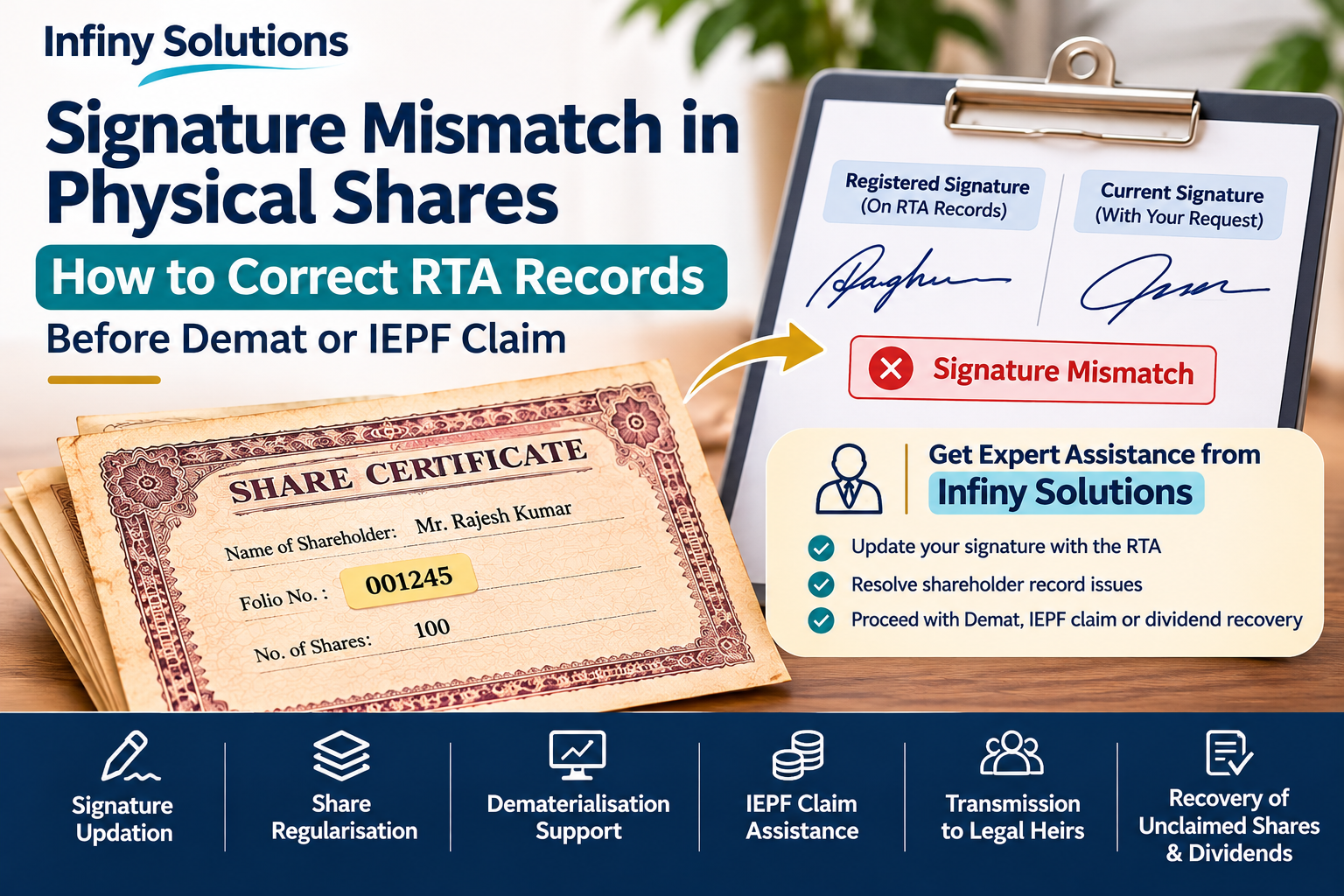
A signature mismatch occurs when a shareholder's current signature differs from the specimen signature maintained in the company's historical shareholder records.
When investors submit requests related to physical shares, the company or its Registrar and Transfer Agent (RTA) may compare their current signature with the signature on record.
If the signatures do not match, further verification may be required before the request can proceed.
While this process protects shareholders against unauthorised access to their investments, it can create difficulties for genuine investors whose signatures have changed over time.
Through our signature updation services, Infiny Solutions helps shareholders address these discrepancies and prepare the appropriate documentation.
Why Does a Signature Mismatch Occur?
Physical share investments are often held for several decades. During this period, a person's signature may naturally change.
Common reasons for signature mismatches include:
Changes in signature due to age.
Differences between old and current handwriting.
Changes in signature after marriage.
Inconsistent signatures across historical documents.
Missing specimen signature records with the RTA.
Health conditions affecting handwriting.
Differences between bank and shareholder records.
Many investors remain unaware of these discrepancies until they attempt to recover their shares, update their KYC or convert physical shares into electronic form.
How Can a Signature Mismatch Affect Share Recovery?
A signature mismatch can affect several shareholder service requests.
Shareholder Request | Potential Impact |
|---|---|
Dematerialisation of physical shares | Request may be returned for further verification |
IEPF share recovery | Additional verification may be required |
KYC updation | Signature verification may be necessary |
Lost share certificate recovery | Ownership verification may become more complex |
Unclaimed dividend recovery | Updated shareholder records may be required |
Transmission of shares | Additional verification of surviving holders or claimants may be needed |
At Infiny Solutions, we assess the overall condition of your shareholder records rather than treating the signature mismatch as an isolated problem.
This helps identify other documentation issues that may affect the recovery of your investments.
Minor vs Major Signature Mismatch in Shares
The applicable investor service framework distinguishes between minor and major signature mismatches.
Minor Signature Mismatch
A minor mismatch refers to small differences between the signature registered with the RTA and the shareholder's current signature.
The RTA may follow the applicable notification and verification procedure before processing the request.
Depending on the outcome, further documentation may be required.
Major Signature Mismatch
A major mismatch involves significant differences between the registered and current signatures.
Similar verification requirements may apply when historical specimen signatures are unavailable.
The shareholder may need to register a fresh signature through Form ISR-1 and complete the applicable banker verification or in-person verification process.
Our team at Infiny Solutions can review the available RTA correspondence and help identify the appropriate next steps.
What Is Form ISR-2 for Signature Verification?
Form ISR-2 is used to obtain confirmation of a securities holder's signature from their banker.
It supports the verification process when shareholders need to register or update their specimen signature with the RTA through the banker verification route.
Form ISR-1 is used for registering or updating applicable shareholder information.
Not every signature mismatch requires Form ISR-2. The appropriate process depends on the nature of the discrepancy and the verification options available.
Incorrectly completed forms or inconsistent bank details can lead to further correspondence and delays.
At Infiny Solutions, we assist shareholders with identifying the relevant forms and preparing the supporting documentation.
Documents Required for Signature Correction in Physical Shares
The documents required for signature updation depend on the nature of the mismatch and the applicable verification process.
The following documents and information may be relevant:
Folio number.
Physical share certificate details.
Form ISR-1.
Form ISR-2, where applicable.
PAN card.
Cancelled cheque or accepted bank records.
Identity and address proof, where required.
Previous correspondence from the company or RTA.
Rejection letter, if the request has already been returned.
Investors may also need to address other shareholder record discrepancies before proceeding with their recovery application.
Our share regularisation services help investors understand and address these requirements.
Signature Mismatch During Dematerialisation of Shares
Have you submitted your old physical share certificates for dematerialisation, only to receive a rejection due to a signature mismatch?
This can happen when the signature submitted with the Demat Request Form differs from the historical specimen signature maintained by the RTA.
Simply resubmitting the same documents may not resolve the underlying problem.
The shareholder may first need to complete the applicable signature verification or updation process. Other discrepancies involving names, addresses or KYC information may also require attention.
Through our dematerialisation of shares services, Infiny Solutions assists investors with reviewing these discrepancies, preparing documentation and navigating the applicable process.
Signature Mismatch During an IEPF Claim
Investors attempting to recover shares from the Investor Education and Protection Fund (IEPF) may encounter discrepancies in historical shareholder records.
During company verification, differences may be identified between the original shareholder records and the documents submitted by the claimant.
These discrepancies may include:
Signature mismatches.
Incorrect or outdated shareholder names.
Missing PAN information.
Old residential addresses.
Inconsistent bank account details.
Differences in Demat account information.
A signature mismatch does not automatically mean that your IEPF claim is ineligible. However, additional verification may be required before the claim can proceed.
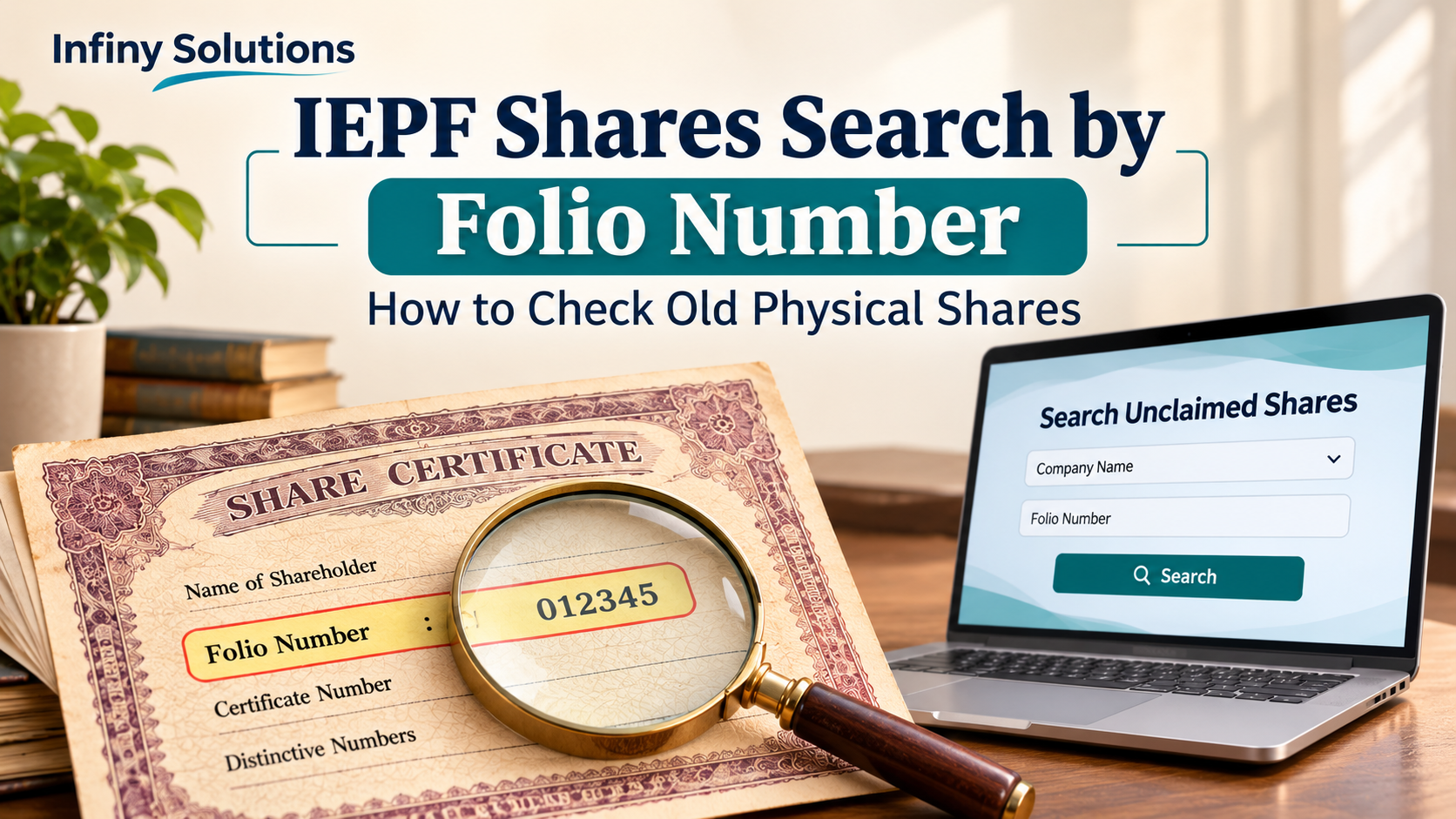
If you are unsure whether your old shares have been transferred to IEPF, read our guide on how to check shares transferred to IEPF.
Our IEPF claim services assist investors with shareholder record reviews, documentation and the applicable recovery process.
What If the Original Shareholder Has Passed Away?
Families often discover old physical share certificates after the death of a parent, grandparent or another family member.
In these situations, submitting a normal signature updation request in the deceased shareholder's name is not the appropriate solution.
Instead, surviving shareholders, nominees or legal heirs may need to establish their entitlement and complete the applicable transmission requirements.
The process can become more complex when:
Original share certificates are missing.
Nomination details are unavailable.
Multiple legal heirs are involved.
Shareholder records are incomplete.
Shares have already been transferred to IEPF.
Through our transmission of shares services, Infiny Solutions assists eligible legal heirs and nominees with the relevant documentation and recovery formalities.
How Infiny Solutions Helps Resolve Signature Mismatches
Correcting a signature is often only one part of recovering an old investment.
At Infiny Solutions, our approach considers the overall status of your shareholding, documentation and recovery requirements.
1. Review of Shareholder Records
We review available share certificates, folio information and correspondence from the company or RTA to understand the nature of the discrepancy.
2. Identification of the Correct RTA
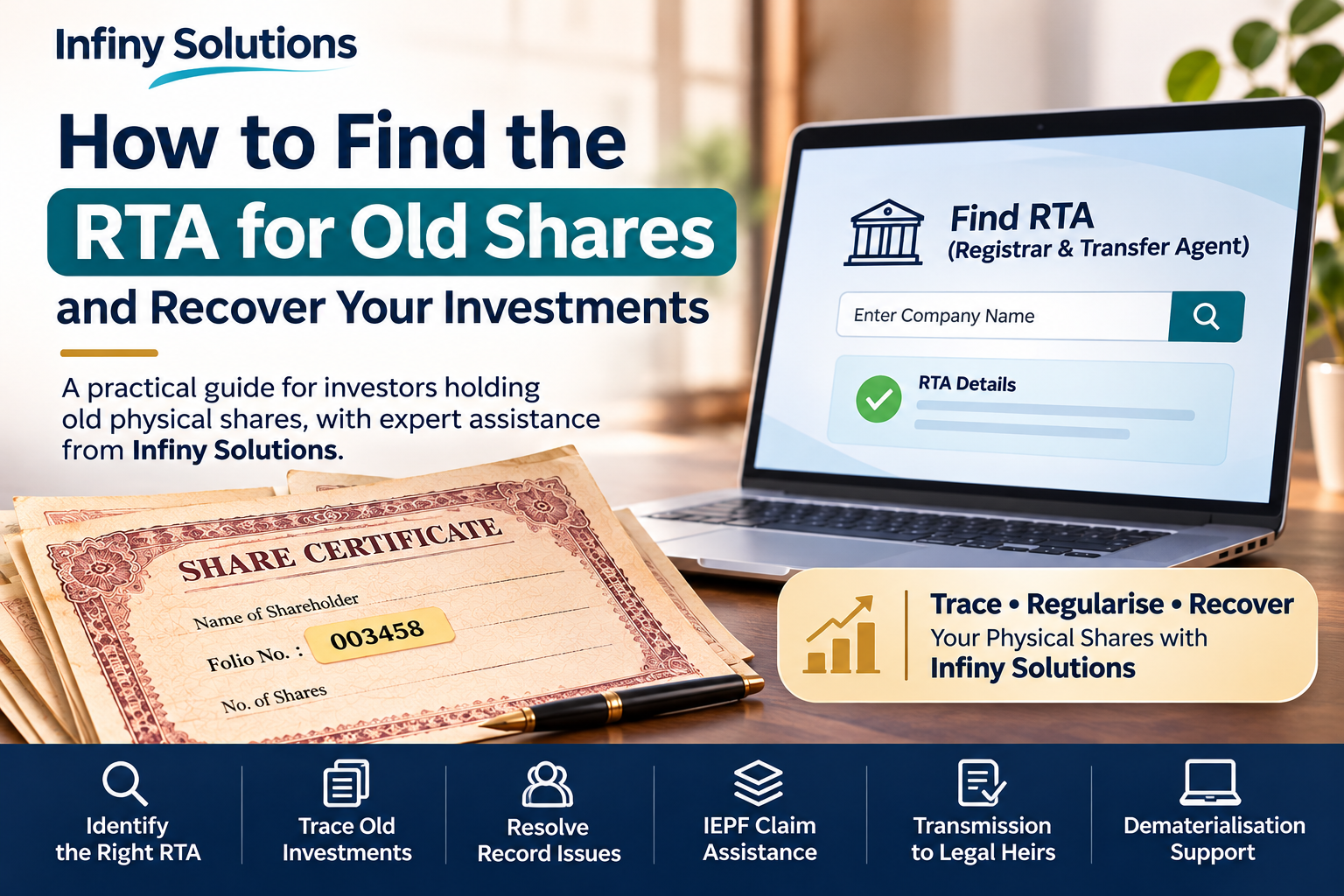
We assist in identifying the company or registrar responsible for maintaining your shareholder records.
This is particularly useful when companies have changed their registrars, merged or undergone corporate restructuring.
3. Documentation and Form Preparation
We assist with preparing applicable investor service forms, supporting documents and signature verification requirements.
4. Shareholder Record Regularisation
Where necessary, we help address related issues such as outdated KYC, address discrepancies and incomplete bank details.
5. RTA Coordination and Follow-Ups
We assist with relevant submissions, correspondence and follow-ups, subject to the agreed scope of services.
6. Assistance With Further Share Recovery
Once the applicable record issues have been resolved, we assist investors with the next stage of their recovery case, whether it involves dematerialisation, IEPF claims or other shareholder services.
All requests remain subject to verification and approval by the concerned organisations.
Common Mistakes That Can Delay Signature Correction
Shareholders attempting to resolve signature discrepancies should avoid the following mistakes:
Submitting forms without understanding the reason for rejection.
Sending documents to an outdated or incorrect registrar.
Using inconsistent signatures across application forms.
Providing bank details that do not match verification documents.
Ignoring additional KYC discrepancies.
Attempting to reproduce an old signature instead of following the prescribed verification process.
Submitting fresh recovery applications without addressing unresolved objections.
Professional assistance from Infiny Solutions can help identify documentation gaps and avoid unnecessary submissions.
Can One Signature Update Cover Multiple Companies?
Many investors hold old physical shares across several companies.
Where multiple folios are maintained by the same RTA, applicable signature updates may be extended across those folios with the shareholder's specific authorisation.
However, updating your signature with one registrar does not automatically update records maintained by other registrars.
At Infiny Solutions, we assist investors with reviewing investments across multiple companies and identifying the relevant documentation and regularisation requirements.
If you are unsure about all the investments held in your name, explore our free unclaimed shares search by name.
Why Choose Infiny Solutions for Signature Correction and Share Recovery?
Resolving a signature mismatch can involve multiple organisations, verification procedures and documentation requirements.
Infiny Solutions provides professional assistance across several areas of shareholder services, including:
Signature updation and correction.
Shareholder KYC regularisation.
Recovery of unclaimed shares and dividends.
IEPF claim assistance.
Dematerialisation of physical shares.
Lost share certificate recovery.
Transmission of shares to legal heirs.
Recovery of old family investments.
Our objective is to help investors understand the status of their investments and navigate the appropriate recovery process.
Professional assistance is optional and does not replace official verification or approval requirements.
Frequently Asked Questions
How do I correct a signature mismatch in physical shares?
You may need to update your specimen signature with the concerned company or RTA using the applicable investor service forms and verification process. Infiny Solutions can assist with reviewing the discrepancy and preparing the relevant documents.
Is Form ISR-2 mandatory for signature updation?
Not in every case. Form ISR-2 is used for banker confirmation when the applicable verification process requires it. In-person verification with the RTA may also be available.
Can a signature mismatch prevent dematerialisation?
Yes. A signature discrepancy can result in a dematerialisation request being returned or requiring additional verification before processing.
Can I recover IEPF shares if my signature has changed?
A change in signature does not automatically make you ineligible for recovery. However, the concerned company may require further verification to establish your identity and entitlement.
What if my old signature records are unavailable?
The applicable process allows for registration of a specimen signature when historical signature records are unavailable, subject to the prescribed verification requirements.
How long does signature correction with an RTA take?
Processing time depends on the nature of the mismatch, completeness of documents, applicable verification requirements and other outstanding shareholder record issues.
Can Infiny Solutions handle signature mismatches across multiple companies?
Yes. We assist shareholders with reviewing records and addressing signature discrepancies across different companies and registrars, subject to applicable requirements.
Can Infiny Solutions help with a rejected Demat or IEPF application?
Yes. Our team can review the available rejection correspondence, identify potential documentation gaps and assist with the appropriate next steps.
Conclusion
A signature mismatch in physical shares can create an unexpected obstacle when investors attempt to recover old investments, claim unclaimed dividends or convert physical certificates into electronic form.
However, a changed signature does not automatically mean that your investments cannot be recovered.
With the appropriate verification, documentation and shareholder record updates, eligible investors may be able to resolve the discrepancy and proceed with the relevant recovery process.
At Infiny Solutions, we provide professional assistance across signature updation, KYC regularisation, dematerialisation, transmission and IEPF share recovery.
Are your old shares stuck because of a signature mismatch or rejected application?
Contact Infiny Solutions to discuss your shareholding records and understand the appropriate next steps towards recovering your investments.