If you still have an old physical share certificate, the folio number can help you trace the holding and check whether the shares or unpaid dividends have been transferred to the Investor Education and Protection Fund Authority (IEPFA).
The IEPFA search facility supports searches using the company name together with a Demat ID or folio number. The folio number is also required in Form IEPF-5 for claims involving physical holdings.
You can initiate the search through Infiny Solutions, and discuss our success fees based structure.
Whether you have discovered old share certificates belonging to yourself, your parents or your grandparents, a folio number can be a useful starting point for tracing these investments.
How Does a Folio Number Help You Trace Old Physical Shares?
A folio number is the reference used by a company or its Registrar and Transfer Agent (RTA) to identify a shareholder's physical holding.
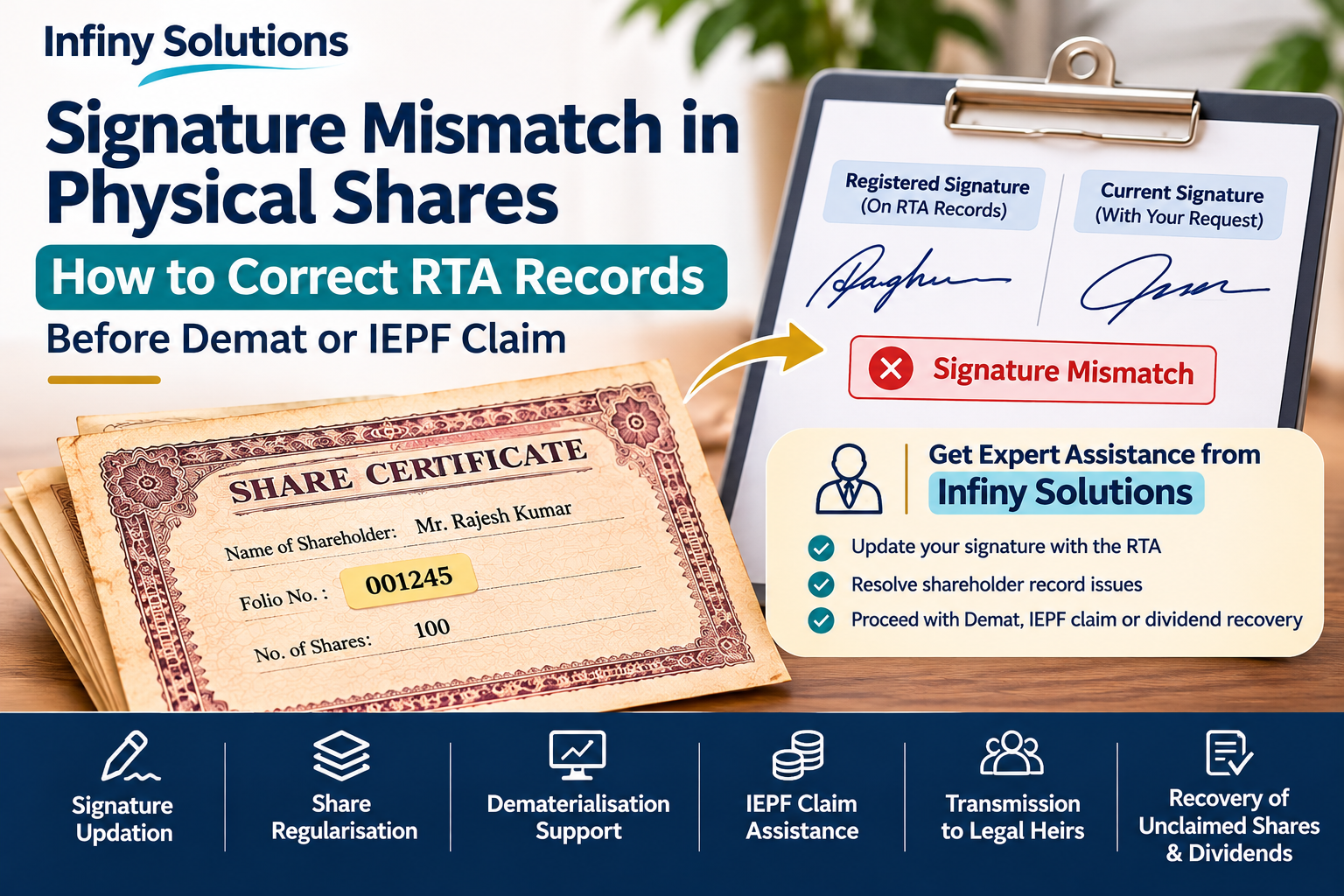
Old physical share certificates normally carry details such as the shareholder's name, folio number, certificate number and distinctive numbers.
If you have found an old certificate in family records, a locker or an old investment file, the folio number is one of the most useful details to start with.
However, finding a folio is only the first step. The holding may be in one of several situations:
The shares may still be recorded with the company or its RTA.
Unpaid dividends may have been transferred to IEPF.
The shares themselves may have been transferred to the IEPF Authority.
The company may have changed its name, merged or appointed a different RTA.
The registered shareholder may have died, in which case transmission may have to be completed before a claim can be processed.
The IEPFA search facility allows investors to trace unclaimed shares, dividends or deposits using PAN, basic information such as name, or company name with Demat ID or folio number.
Folio Number Search vs Name Search vs PAN Search
Search Method | When to Use | Advantages | Limitations |
|---|---|---|---|
Folio number search | You have an old physical certificate, dividend warrant or shareholder correspondence | Specific to the shareholder record and useful for physical holdings | You normally need to identify the correct company as well |
Name search | You do not know the folio number but know the shareholder's name | Useful for tracing forgotten investments | Name variations, spelling changes and common names can create difficulties |
PAN search | You know the shareholder's PAN and the relevant records are linked correctly | Can help identify holdings across available IEPFA records | Very old records may contain outdated details or mismatches |
How to Search IEPF Shares Using a Folio Number
The practical process is straightforward when you still have the certificate or know the folio number.
Step 1: Identify the Company
Check the physical share certificate for the company name.
If it is an old company, confirm whether the business has since changed its name, merged or been acquired. You should use the current company or RTA information where applicable.
Step 2: Locate the Folio Number
The folio number is generally printed on the physical share certificate.
It may also appear on:
Old dividend warrants
Company letters
Shareholder correspondence
RTA communications
Step 3: Use the Official IEPFA Search Facility
Visit the official IEPFA portal and access the search facility for unclaimed amounts and shares.
One of the available search methods uses the company name together with the Demat ID or folio number.
Step 4: Compare the Search Results With Your Records
Check the shareholder name, company and available holding information carefully.
Make sure the information matches your original investment records.
Step 5: Verify the Holding With the Company or RTA
The IEPFA search result does not replace verification with the company.
If you plan to recover shares, the company and its RTA play an important role in confirming the shareholder's entitlement and processing the verification connected with an IEPF-5 claim.
If the search does not return a result, do not assume that the investment has no value. The holding may still remain in the company's physical folio records, the folio details may have changed, or there may be a mismatch in the information being searched.
Information and Documents Required to Search Old Physical Shares
You do not need a complete IEPF claim file simply to search by folio number.
For the initial search, the most useful information is:
Company name
Folio number
Registered shareholder's name
PAN, if available
Physical share certificate details
Certificate and distinctive numbers, if available
Old dividend warrants or company correspondence
If the shares are confirmed as transferred to IEPF and you proceed to recovery, additional documentation will be required.
For a physical holding, Form IEPF-5 requires the folio number from which the securities were transferred to IEPF. The form also requires claimant and company details and information about the shares or amounts being claimed.
Depending on the case, supporting records may include identity details, Demat account information, bank information, relevant share records and documents required for company verification.
Original physical share certificates may also be relevant to a claim. Where certificates have been lost, separate requirements apply under the IEPF rules.
For deceased shareholders, legal heirs, nominees, name mismatches, lost certificates or other irregular cases, the exact documents may vary by RTA, company and the circumstances of the holding.
From Folio Number Search to IEPF Share Recovery
Finding an entry does not automatically return the shares. Search and recovery are two different stages.
A typical folio-based IEPF recovery process involves the following steps:
Stage | Action Required |
|---|---|
Find old records | Identify the company and folio number |
Search IEPFA | Check company and folio details |
Verify the holding | Contact the company or RTA |
Prepare the claim | Resolve mismatches or transmission issues, if required |
File IEPF-5 | Submit the claim through the MCA portal |
Company verification | The company verifies the claim |
IEPFA review | The Authority examines the verified application |
Share recovery | Shares are credited to the eligible Demat account if the claim is approved |
Under the MCA process, Form IEPF-5 is filed through the MCA portal. A Service Request Number (SRN) is generated after submission, followed by acknowledgement and the applicable indemnity bond.
The claimant then completes the document-dispatch steps required by the process, after which the application moves to company verification.
Official rules provide a 30-day framework for company verification in the applicable process. The IEPF Authority is required to dispose of a complete, duly verified claim within 60 days from receipt of the company's complete verification report.
These are regulatory processing periods, not a guarantee that every end-to-end claim will finish within 90 days. Missing documents, discrepancies and resubmissions can extend the actual time.
Common Problems When Searching Old Physical Shares
1. The Folio Number Gives No Results
First, verify the company name and every digit of the folio number.
Also check whether the company has changed its name, merged or changed its RTA.
If necessary, contact the current RTA and request verification of the old physical folio.
2. The Shareholder's Name Is Different
Old certificates may contain initials, spelling differences, maiden names or other variations.
Name mismatches can require supporting proof, such as evidence of the old name or documents supporting a change of name.
3. The Physical Share Certificate Has Been Lost
A missing certificate does not necessarily end the claim, but additional documentation applies.
IEPFA guidance refers claimants to the lost-securities requirements under Schedule III of the applicable IEPF rules.
4. The Registered Shareholder Is Deceased
A legal heir or successor should not simply file a normal claim in the deceased person's name.
Transmission requirements must first be handled in accordance with the applicable IEPF and company or RTA process.
5. The Shares Were Transferred to IEPF Years Ago
A transfer to IEPF does not by itself mean the shareholder's entitlement disappears.
Eligible persons can apply to claim transferred shares and amounts through the prescribed process.
Frequently Asked Questions
Can I search IEPF shares using only a folio number?
The official IEPFA facility includes a search method using the company name plus Demat ID or folio number. Therefore, you should keep both the relevant company name and folio number ready.
Where can I find the folio number of old physical shares?
For physical holdings, it is commonly printed on the share certificate. It may also appear on dividend warrants and old shareholder or RTA correspondence.
Is a folio number the same as a Demat account number?
No. A folio number relates to a physical shareholder record maintained for the issuer. Electronic holdings use depository identifiers associated with a Demat account.
What if I do not know the folio number?
You can try the other search methods supported by IEPFA, including PAN or basic information such as the shareholder's name.
You can also review old certificates, dividend records and company correspondence.
What if my folio number is not shown on the IEPF portal?
Contact the company or its current RTA and ask them to verify the holding. A missing search result does not confirm that the shares are lost or worthless.
Can I claim shares directly after finding them in the search?
Not immediately. A search helps identify the record. Recovery from IEPF requires the prescribed IEPF-5 process and verification by the concerned company.
Do I need a Demat account to receive recovered shares?
Shares refunded through the IEPF process are credited in electronic form to the eligible Demat account specified in the claim process. Accurate Demat details are therefore important.
Is there a government fee for filing an IEPF claim?
IEPFA states that there is no charge for filing a claim with the Authority. Professional assistance, if voluntarily used, is separate from the government's claim process.
How Infiny Solutions Can Assist
Tracing a folio is often easy when the certificate and shareholder details are clear.
The difficulty usually begins when records are incomplete, the company has changed, the shareholder has died, the certificate is lost or the name, signature, address or KYC details do not match.
Infiny Solutions can assist shareholders and their families with:
Tracing old physical shareholdings
Identifying the relevant company and RTA
Understanding IEPF claim requirements
Recovery of unclaimed shares and dividends
Transmission of shares to legal heirs
Lost or duplicate share certificate cases
Shareholder record regularisation
Professional assistance does not replace the official MCA, IEPFA or company verification process, and claim approval cannot be guaranteed.
Conclusion
An IEPF shares search by folio number is a useful starting point for tracing old physical shares and forgotten investments.
Even if your share certificates are several decades old, the folio number may help you identify the holding and understand its current status.
If the shares have been transferred to IEPF, the next step is to verify your entitlement and follow the prescribed recovery process. If the shares remain with the company, you may need to resolve shareholder record or documentation issues.
Have you discovered old physical share certificates or unclaimed investments belonging to your family?
Contact Infiny Solutions to review your available share records and understand the appropriate next steps for your share recovery case.